

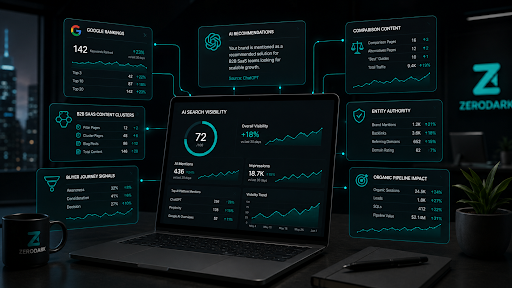
A founder can post every day, ship a better product, and still lose visibility if AI tools do not understand who the company is for, what problem it solves, and why it should be recommended. That is the new search problem startups are facing. GEO for Startups is becoming essential because buyers are no longer only searching Google, clicking ten blue links, and comparing websites manually. They are asking ChatGPT, Gemini, Perplexity, and AI-powered search tools to shortlist solutions, explain categories, compare vendors, and recommend next steps.
This does not mean traditional SEO is dead. That is lazy thinking. SEO still matters because AI systems often depend on accessible, well-structured, credible web content. The real shift is that startups now need to optimize for both search engines and answer engines. If your startup is not clearly positioned across your website, content, and authority signals, AI tools may not understand when to mention you.
What GEO Actually Means for Startups
Generative Engine Optimization, or GEO, is the process of making your brand easier for AI systems to understand, retrieve, summarize, and recommend when users ask relevant questions. For startups, this matters because AI search is often used early in the buyer journey.
A buyer may ask, “What is the best platform for managing customer onboarding?” or “Which tools help B2B SaaS companies reduce churn?” or “What agencies help startups improve AI search visibility?” If your company is not clearly associated with those problems, categories, and outcomes, AI tools may recommend competitors instead. That is the brutal part. You may have a better product, but if your public footprint is thin, vague, or inconsistent, AI systems have less reason to mention you.
Founder-Led Growth Needs a Search Layer
Founder-led growth is powerful because people trust people more than logos. A founder who shares strong opinions, product lessons, customer insights, and category education can build authority faster than a faceless company page.
But visibility on social platforms is not enough. Posts disappear quickly. Algorithms change. Audiences miss updates. Your best ideas need to become durable assets on your website, in case studies, in comparison pages, in explainers, in interviews, and across trusted third-party mentions.
That is where generative engine optimization strengthens founder-led growth. It turns founder insight into structured content that can be discovered, cited, and reused by AI systems. A strong LinkedIn post may create attention for one week. A strong GEO-focused article can help shape how your startup is understood for months.
Why Startups Become Invisible in AI Search
Startups usually become invisible for predictable reasons. Their website explains features but not the category. Their homepage uses clever messaging but lacks plain language. Their blog talks about company updates instead of buyer questions. Their service or product pages do not clearly define use cases. Their case studies are too thin. Their brand is barely mentioned outside their own website.
AI tools need signals. They need clear entities, consistent terminology, trusted sources, and content that answers specific questions. If your site is thin, vague, blocked, or technically messy, you are making the job harder. This is especially important for startups because early-stage companies often lack brand demand. Buyers may not search for your company name yet. They search for the problem, the category, the use case, or the outcome. GEO helps connect your startup to those discovery moments.
GEO Starts With Clear Positioning
Before a startup worries about AI visibility tools, it needs clear positioning. What category are you in? Who do you serve? What painful problem do you solve? What outcome do you create? What alternatives do buyers compare you against? What phrases should your brand be associated with?
Most startups want to rank for broad terms too early. That is usually a mistake. A young company should first own sharper, outcome-based queries. For example, instead of trying to appear for “CRM software,” a startup might target “CRM for founder-led B2B sales teams” or “CRM for early-stage SaaS companies managing investor-led pipeline.” GEO rewards clarity because AI answers are built around meaning. If your messaging is too clever, too generic, or too abstract, you may sound interesting to humans but unclear to machines.
Content Needs to Answer Buyer Questions Directly
Traditional startup content often focuses on announcements, opinions, and product updates. GEO-focused content answers the questions buyers are already asking AI.
That includes best tools questions, comparison questions, how-to-choose questions, risk questions, cost questions, category education, implementation questions, and use-case questions. A startup should build content around the exact questions a buyer would ask before entering a sales conversation. This does not mean writing robotic FAQ pages. It means creating useful, specific, experience-based content. AI systems are more likely to surface content that clearly explains a concept, compares options honestly, and gives practical context.
Your Website Must Be Easy to Parse
For AI search visibility, your website needs to be clear for both humans and machines. That means descriptive headings, clean page structure, specific service or product pages, schema where appropriate, fast loading, crawlable content, and obvious internal links.
If your key value proposition only appears inside graphics, animations, videos, or vague hero copy, you are weakening your visibility. AI systems and search engines need accessible text that explains what you do. For startups, the core pages usually include a homepage, product or service pages, use-case pages, comparison pages, pricing or packaging guidance when possible, customer stories, and educational content. Each page should have a clear job.
Third-Party Mentions Matter More Than Startups Think
Your own website is only one part of GEO. AI tools often look for confirmation across the web. If your startup claims to be the best option for a market but no one else mentions you, the claim is weaker. This is why PR, podcasts, partner pages, review sites, founder interviews, guest posts, customer stories, and community mentions can help. The goal is not fake authority. The goal is to create real proof that your company exists in the category and is trusted by others.
For ZeroDark, this is where GEO for Startups should connect with strategy, not just content writing. Startups need a visibility system that combines positioning, SEO, founder-led content, technical structure, and authority building.
The New SEO Is Not Replacing the Old One
The phrase “GEO is the new SEO” is useful, but it can be misleading. GEO does not replace SEO. It expands it. Search engines, AI answer engines, and human buyers are now connected. Google’s documentation on AI features in Search explains that site owners should follow the same SEO fundamentals for AI experiences, including creating helpful, crawlable, people-first content.
The practical takeaway is simple. Your startup cannot only optimize for rankings. It also needs to optimize for being understood, trusted, and recommended inside AI-generated answers. Ranking on Google still matters, but being included in AI-generated summaries, comparisons, and recommendations is becoming part of the same visibility system.
What ZeroDark Would Build First
For a startup beginning GEO, the first move is not publishing twenty random blog posts. The first move is building a visibility foundation. That means defining the core category, mapping buyer questions, creating high-intent landing pages, strengthening internal links, improving technical crawlability, building comparison content, publishing founder-led POV articles, and creating proof assets that explain real outcomes.
A strong starting structure might include a category page, three to five use-case pages, two comparison pages, four problem-led blog posts, one founder POV page, and one customer story. That is more useful than chasing broad keywords with generic content. The goal is to make your startup easier to understand from every angle. Your homepage should explain the big promise. Your service or product pages should clarify what you do. Your blog should answer buyer questions. Your case studies should prove outcomes. Your third-party mentions should support credibility.
Stop Letting AI Define Your Category Without You
If your startup does not explain itself clearly, AI systems will either ignore it or define it poorly. That is not a future problem. It is already happening as buyers use AI tools to research vendors, understand categories, and make shortlists before they ever fill out a form.
ZeroDark helps startups build GEO for Startups, generative engine optimization, AI search visibility, startup SEO, and founder-led content systems that make the company easier to discover, understand, and trust. The goal is not to trick AI tools. The goal is to make your startup impossible to misunderstand when buyers and answer engines are looking for solutions like yours.
FAQs
What is GEO for startups?
GEO for Startups means optimizing a startup’s website, content, positioning, and authority signals so AI tools like ChatGPT, Gemini, Perplexity, and AI-powered search experiences can better understand and recommend the company for relevant buyer questions.
Is GEO different from SEO?
Yes, but they overlap. SEO focuses on improving visibility in search engines, while GEO focuses on improving visibility in AI-generated answers. Startups need both because AI tools often rely on crawlable, credible, well-structured web content.
Why does AI search visibility matter for startups?
AI search visibility matters because buyers increasingly use AI tools to research categories, compare vendors, and shortlist solutions. If a startup is not visible in those answers, it may lose demand before the buyer ever visits its website.
What should startups do first for GEO?
Startups should start with clear positioning, crawlable website content, buyer-question mapping, high-intent landing pages, comparison content, founder-led POV articles, internal linking, and credible third-party mentions.