

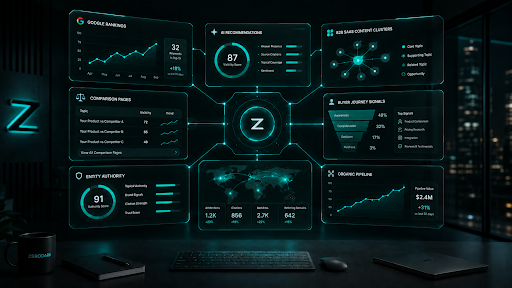
A B2B SaaS brand can rank on Google and still be missing from the conversations where buyers are now forming opinions. That is the uncomfortable shift. Buyers are not only typing keywords into search engines anymore. They are asking AI tools to explain categories, compare vendors, summarize best options, recommend frameworks, and reduce research time. That means AI search visibility is no longer a future marketing experiment. It is becoming part of how SaaS companies get discovered, evaluated, and trusted.
This does not mean you should abandon Google rankings. That would be reckless. Google still matters, traditional SEO still matters, and high-intent organic traffic still matters. But the content that wins in 2026 needs to work harder. It must be clear enough for search engines, useful enough for buyers, structured enough for AI systems, and credible enough to be recommended.
Rankings Are Only One Layer of Visibility Now
For years, SaaS content teams treated ranking as the main goal. If a page reached page one, the strategy was considered successful. That thinking is now incomplete. A buyer might see your article in Google, skim an AI Overview, ask ChatGPT for vendor options, check Reddit or LinkedIn for opinions, compare your site with competitors, and then ask an internal team member for feedback. Visibility is fragmented across search engines, AI tools, communities, review platforms, and social proof.
That means your content cannot only be designed to rank. It must be designed to travel. It needs clear definitions, strong positioning, practical answers, comparison angles, proof, and consistent terminology that can be understood across channels. For ZeroDark, this is where SEO for B2B and generative engine optimization need to work together instead of competing.
AI Recommendations Need Clear Brand Associations
AI systems do not recommend a company because the website uses clever copy. They need clear associations. What does the brand do? Who does it serve? What problem does it solve? What category does it belong to? What makes it different? What proof supports the claim?
If your content does not answer those questions repeatedly and consistently, you make your brand harder to understand.
For B2B SaaS companies, this is a common problem. The homepage sounds polished but vague. Blog posts talk around the topic. Product pages explain features without naming buyer problems. Case studies mention outcomes but do not explain context. The result is a brand that may look professional to humans but appears unclear to machines. A strong B2B SaaS content strategy should build category clarity on purpose. Every important page should reinforce what the company wants to be known for.
The Old Content Calendar Is Not Enough
A content calendar filled with random blog topics is not a visibility strategy. It is production activity. The new playbook starts with question mapping. What do buyers ask before they know your category? What do they ask when comparing solutions? What do they ask when trying to justify budget? What do they ask when evaluating risk? What do they ask AI tools when they want a short list?
From there, content should be grouped into clusters. You need pillar pages, comparison pages, use-case pages, alternative pages, FAQ-driven pages, founder POV articles, case studies, technical explainers, and conversion pages. Each page should play a specific role in the buyer journey. This matters because AI tools often respond to specific questions. If your content does not directly address those questions, you are relying on luck.
Write for Retrieval, Not Just Reading
Good content still needs to be readable, persuasive, and human. But it also needs to be easy to retrieve.
Retrieval-friendly content uses clear headings, direct answers, defined terms, concise explanations, logical structure, internal links, and consistent language. It avoids burying the main point under five paragraphs of setup. It explains who the content is for and what problem it addresses. This does not mean writing boring content. It means respecting how modern discovery works. AI tools need to extract meaning. Search engines need to crawl and classify pages. Buyers need to scan quickly. Sales teams need content that answers objections.
One page now has to serve multiple readers.
Your Content Needs Stronger Proof Signals
AI recommendations and B2B buyers both need proof. Claims alone are weak.
If you say your SaaS platform improves onboarding, show how. If you claim your product reduces manual work, explain the workflow before and after. If you say your solution is easier to implement, give the implementation path. If you claim to serve enterprise teams, show evidence that enterprise buyers would trust.
Proof can come from case studies, customer quotes, product screenshots, benchmarks, process diagrams, integration details, methodology pages, founder insights, third-party mentions, and comparison content. This is where many SaaS brands fall short. They publish educational content but fail to connect it to credibility. The content may be useful, but it does not make the brand more recommendable.
GEO and SEO Should Share the Same Foundation
Some marketers are treating GEO like a separate channel with separate tricks. That is a mistake. GEO for Startups and SEO for B2B both depend on clarity, crawlability, authority, structure, and usefulness. The difference is emphasis. SEO often focuses on rankings, traffic, and search intent. GEO focuses more on how AI systems understand, summarize, and recommend a brand. But the foundation overlaps heavily.
Google’s documentation on AI features in Search explains that site owners should follow the same SEO fundamentals for AI experiences, including creating helpful, crawlable, people-first content. The takeaway is simple. Do not build a fake AI content strategy. Build a stronger visibility system.
Comparison Content Is Becoming More Valuable
B2B SaaS buyers love comparison content because it saves time. AI tools also rely on comparison-style information when users ask for recommendations or alternatives. That means your website should include honest comparison pages where appropriate. Not cheap attack pages. Real comparison content that explains fit, tradeoffs, use cases, pricing considerations, implementation differences, strengths, limitations, and decision criteria.
Examples include product versus product pages, alternative pages, best tools for specific use cases, platform category explainers, and “how to choose” guides. These pages help buyers evaluate and help AI systems understand where your brand fits. The brands that avoid comparison content often let competitors and third-party sites define them.
Founder-Led POV Can Shape AI Visibility
Founder-led content is not only a social media tactic. It can become part of the visibility system when converted into durable web assets.
A founder’s strong point of view can explain why the market is changing, what buyers misunderstand, what category assumptions are broken, and what the company believes differently. These ideas can become blog posts, landing pages, interviews, newsletters, and comparison frameworks.
For startups and B2B SaaS brands, this matters because original POV is harder to copy than generic SEO content. It gives AI tools and buyers more specific context about how your company thinks. A brand that only publishes safe content becomes forgettable. A brand with clear, useful opinions becomes easier to remember and cite.
Technical Structure Still Matters
AI visibility is not only a writing problem. Your website still needs strong technical foundations.
Pages should load quickly, be mobile-friendly, use crawlable text, have descriptive title tags, include clean internal links, and avoid hiding important information inside images or scripts. Schema can help clarify page types when used properly. A clear site architecture helps both humans and machines understand the relationship between services, topics, use cases, and proof. If your site is technically messy, your content has to fight harder than it should.
This is especially important for SaaS companies where product information, integrations, documentation, and marketing content may be spread across different subdomains or platforms. Structure affects discovery.
Measure More Than Traffic
The old SEO dashboard focused heavily on impressions, rankings, clicks, and sessions. Those still matter, but they are not enough.
A modern visibility dashboard should also watch branded search growth, assisted conversions, qualified leads, demo requests, content-assisted pipeline, mentions in AI search tools where trackable, referral quality, comparison page engagement, and bottom-funnel content performance. The goal is not to celebrate traffic for its own sake. The goal is to understand whether content is increasing buyer confidence and market visibility.
A page with modest traffic but high sales influence may be more valuable than a high-traffic article that attracts the wrong audience.
Build Content That Can Be Found, Understood, and Recommended
The future of B2B SaaS content is not Google versus AI. It is Google plus AI plus human buyer behavior. The winning brands will build content that ranks, explains, proves, compares, and converts. They will not rely on generic blogs or keyword volume alone. They will create structured visibility systems that help buyers and AI tools understand exactly why the brand deserves attention.
ZeroDark helps companies build AI search visibility, GEO for Startups, SEO for B2B, generative engine optimization, and B2B SaaS content strategy that supports both traditional search and AI recommendations. If your content is only built to chase rankings, it may be solving yesterday’s visibility problem. The next advantage belongs to brands that can be found, understood, and recommended.
FAQs
What is AI search visibility for B2B SaaS?
AI search visibility means making a B2B SaaS brand easier for AI tools and AI-powered search experiences to understand, summarize, and recommend when buyers ask relevant questions.
Is GEO replacing SEO for B2B companies?
No. GEO is not replacing SEO. It expands SEO by focusing on how AI systems understand and recommend content. B2B companies need both traditional search visibility and AI recommendation visibility.
What type of content helps with AI recommendations?
Content that helps with AI recommendations includes clear service pages, comparison pages, use-case content, FAQs, case studies, founder POV articles, technical explainers, and content that directly answers buyer questions.
How should B2B SaaS brands measure content visibility?
B2B SaaS brands should measure rankings, organic traffic, qualified leads, demo requests, branded search growth, comparison page engagement, assisted pipeline, and visibility in AI-driven discovery where possible.