

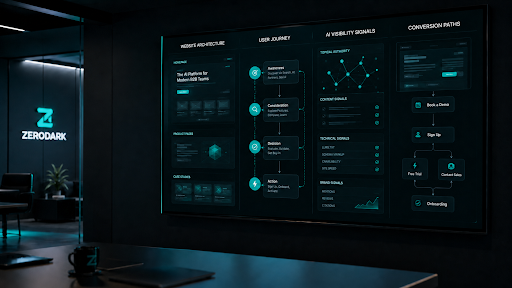
A SaaS website used to be treated like a polished front desk. It welcomed visitors, explained the product, showed a few screenshots, and pointed people toward a demo button. That model is outdated. Today, your website has to do much more than look credible. It has to educate buyers, reduce friction, support evaluation, communicate positioning, capture demand, and increasingly make your company easier for search engines and AI systems to understand. That is why Web Design and Development for SaaS has become a growth function, not just a design task.
This shift matters because most SaaS buyers do not arrive ready to convert. They compare vendors, read use cases, scan pricing clues, validate trust, ask AI tools for recommendations, review integrations, and try to understand how quickly your product can solve their problem. If your website behaves like a static brochure, you create doubt. If it behaves like a structured buying system, you create momentum.
Your Website Now Sits in the Middle of the Buying Journey
A SaaS buyer rarely discovers your brand and books a demo in one step. They move through questions. What problem does this solve? Is it for companies like mine? How is it different from alternatives? Will it fit our workflow? Is it credible enough to present internally? What happens after signup? How long does implementation take? Can I trust this company?
Your website is where those questions either get answered or ignored.
That is why SaaS website design should not be treated as visual polish alone. A strong SaaS website must guide the buyer through clarity, proof, and next steps. Every page should have a job. The homepage should frame the category and value proposition. Product pages should explain capabilities in plain language. Use-case pages should connect the solution to specific problems. Comparison pages should help evaluators choose. Case studies should reduce risk. The site as a whole should move visitors from curiosity to confidence.
Trust Is Now a Design Outcome
Most SaaS websites say the same things. They claim to be fast, scalable, intuitive, secure, and built for growth. Those words have been drained of meaning. Buyers do not trust them by default. Trust now comes from how the site is structured and what it proves. Does the messaging feel clear or evasive? Are there real customer outcomes or just brand logos? Is the site easy to navigate, or does it force users to hunt for basic information? Are product screenshots meaningful, or are they decorative? Are there comparison pages, integration details, pricing guidance, implementation expectations, and onboarding explanations?
This is where conversion-focused web design becomes strategic. Good design reduces confusion. It helps the buyer feel that the company is organized, credible, and serious. Bad design does the opposite. It creates hesitation, and hesitation kills demos before a form is ever submitted.
A SaaS Website Must Support Different Decision-Makers
SaaS buying is often influenced by multiple people. A founder may care about speed and growth. A marketing leader may care about workflow and reporting. An operations lead may care about implementation. A technical evaluator may care about integrations and security. Finance may care about pricing logic and contract risk.
If your website only speaks to one type of visitor, you lose the rest.
A strong B2B SaaS website builds paths for different buying roles without becoming cluttered. This does not mean you need separate microsites for every persona. It means the content architecture should make it easy for different evaluators to find the answers relevant to them. This is a design problem and a content problem at the same time.
Development Quality Shapes More Than User Experience
Design gets most of the attention, but development quality quietly shapes performance, crawlability, and conversion. A site that looks good but loads slowly, breaks on mobile, hides content behind scripts, or creates technical SEO issues is undermining its own growth.
Google’s guidance on Core Web Vitals makes it clear that site speed, responsiveness, and visual stability affect user experience in meaningful ways. For SaaS companies, this matters because friction compounds. A slow page, a clumsy menu, a lagging demo form, or broken mobile experience may be enough to push a qualified visitor back to a competitor.
That is why SaaS web development should be treated as part of demand generation. Clean development supports SEO, AI visibility, page speed, crawlability, accessibility, and trust.
AI Visibility Starts With Better Website Structure
AI tools are changing how buyers research software. They ask which tools are best for a specific workflow, which platforms integrate well, which vendors fit a certain stage of growth, and which options are easier to implement. If your site is vague, your company becomes harder to recommend.
A website that supports AI visibility usually has clear headings, precise page titles, accessible text, strong internal links, distinct use-case pages, specific product explanations, and credible proof across the site. AI systems need clarity. They need to see what the product does, who it serves, how it compares, and why it is trusted. A flashy site with weak structure may impress visually but still fail in discovery. This is why SaaS web design can no longer be separated from information architecture. The site has to work for buyers and machines.
Your Homepage Should Not Try to Do Everything
One common SaaS mistake is overloading the homepage. Teams try to explain every feature, every use case, every audience, every proof point, and every product detail on one page. The result is usually weak positioning and visual noise.
The homepage should do three things well. First, it should clearly explain what the product is and who it is for. Second, it should create enough trust to keep the visitor exploring. Third, it should guide users toward the right next step, whether that is a product page, use-case page, pricing page, comparison page, or demo action.
The homepage is not the whole story. It is the entry point into a system.
SaaS Websites Need More Than Features
Many SaaS websites are still built around feature lists. Features matter, but buyers do not purchase features in isolation. They purchase outcomes, confidence, and reduced risk.
That is why the strongest SaaS sites connect product capabilities to business results. Instead of only saying what the platform includes, the site should explain what changes for the customer. Does it reduce churn? Improve onboarding? Speed up reporting? Shorten sales cycles? Create visibility for managers? Eliminate manual work? Help teams collaborate better?
A strong SaaS website strategy translates capability into impact. That is what makes the buyer feel the product is worth pursuing.
Design Should Support Conversion Without Feeling Desperate
Some SaaS sites swing too far in the other direction and turn every page into a hard-sell environment. Pop-ups appear too early. Demo buttons compete with every paragraph. The site feels impatient.
That usually backfires in B2B, where buyers need time and context.
Good conversion design is not about shouting louder. It is about making the next step feel natural. Calls to action should fit the page intent. A homepage may encourage exploration or demo interest. A pricing page may encourage a sales conversation. A case study may point toward related use cases. A bottom-funnel page may invite a direct consultation.
The more aligned the CTA is with the buyer’s mindset, the more effective the page becomes.
The Best SaaS Websites Are Built Like Systems
A real SaaS website is not a homepage plus a few product pages. It is a structured system of trust, discovery, education, and conversion. It supports search. It supports AI visibility. It supports sales. It supports positioning. It supports proof. It supports expansion as the company grows.
That is why redesigns fail when they focus only on visuals. A new color palette, better typography, and updated screenshots will not fix a weak site strategy. What matters is how the information flows, how the pages connect, how the messaging is framed, and how the user moves through the site.
Stop Treating Your Website Like a Digital Brochure
Your SaaS website is no longer just a brand asset. It is a buyer education platform, a trust engine, a search asset, an AI discovery layer, and a conversion system. If it is still behaving like a static brochure, it is underperforming.
ZeroDark helps brands build Web Design and Development for SaaS, SaaS website design, SaaS web development, and growth-focused website systems that improve trust, support pipeline, and strengthen AI visibility. The goal is not to make your site look newer. The goal is to make it work harder for the way modern buyers actually evaluate software.
FAQs
Why is web design and development important for SaaS companies?
Web Design and Development for SaaS matters because the website often shapes first impressions, buyer trust, search visibility, AI discoverability, and conversion performance before a sales conversation ever begins.
What makes a SaaS website different from a normal business website?
A SaaS website usually needs to support longer buyer journeys, multiple decision-makers, product education, trust-building, feature explanation, proof, and conversion paths across different stages of evaluation.
Can better website design improve SaaS conversions?
Yes. Better design can improve SaaS conversions by making messaging clearer, reducing confusion, improving navigation, strengthening proof, aligning CTAs with user intent, and helping buyers move through the evaluation process more confidently.
Does web development affect AI visibility and SEO?
Yes. Strong development supports page speed, crawlability, site structure, mobile experience, and content accessibility, all of which influence SEO and help AI systems better understand and surface your site.