Begin with the search experience, not the acronym
SEO concerns making useful website content discoverable and understandable in search. AEO and GEO are terms commonly used for work aimed at answer engines and generative search experiences. Vendor definitions vary, so ask what concrete changes and observations a proposal actually includes. For Google’s generative search features, its current guidance says foundational SEO remains relevant. It does not prescribe a special markup format or a separate page for every wording of a question. A useful plan should explain the buyer need, the page change and the evidence to revisit.
Compare the practical tasks
| Task | Example | How to assess it |
|---|---|---|
| Search accessibility | Make the intended page publicly crawlable after launch | Verify the actual production response and controls |
| Content clarity | Explain a service, fit, process and limits | Review whether a buyer’s question is answered |
| Supporting evidence | Add an authentic demonstration or substantiated example | Inspect the source and its relevance |
| Answer observation | Check a fixed buyer question on a named platform | Preserve date, answer and cited sources |
| Business measurement | Review qualified inquiry paths | Validate tracking and source definitions |
These tasks overlap. A single clear service explanation can help a reader arriving through a search result, an AI citation or a direct link. Rewriting the same answer into several acronym-targeted articles does not automatically add useful coverage.
Use the demo to separate assessment from observation
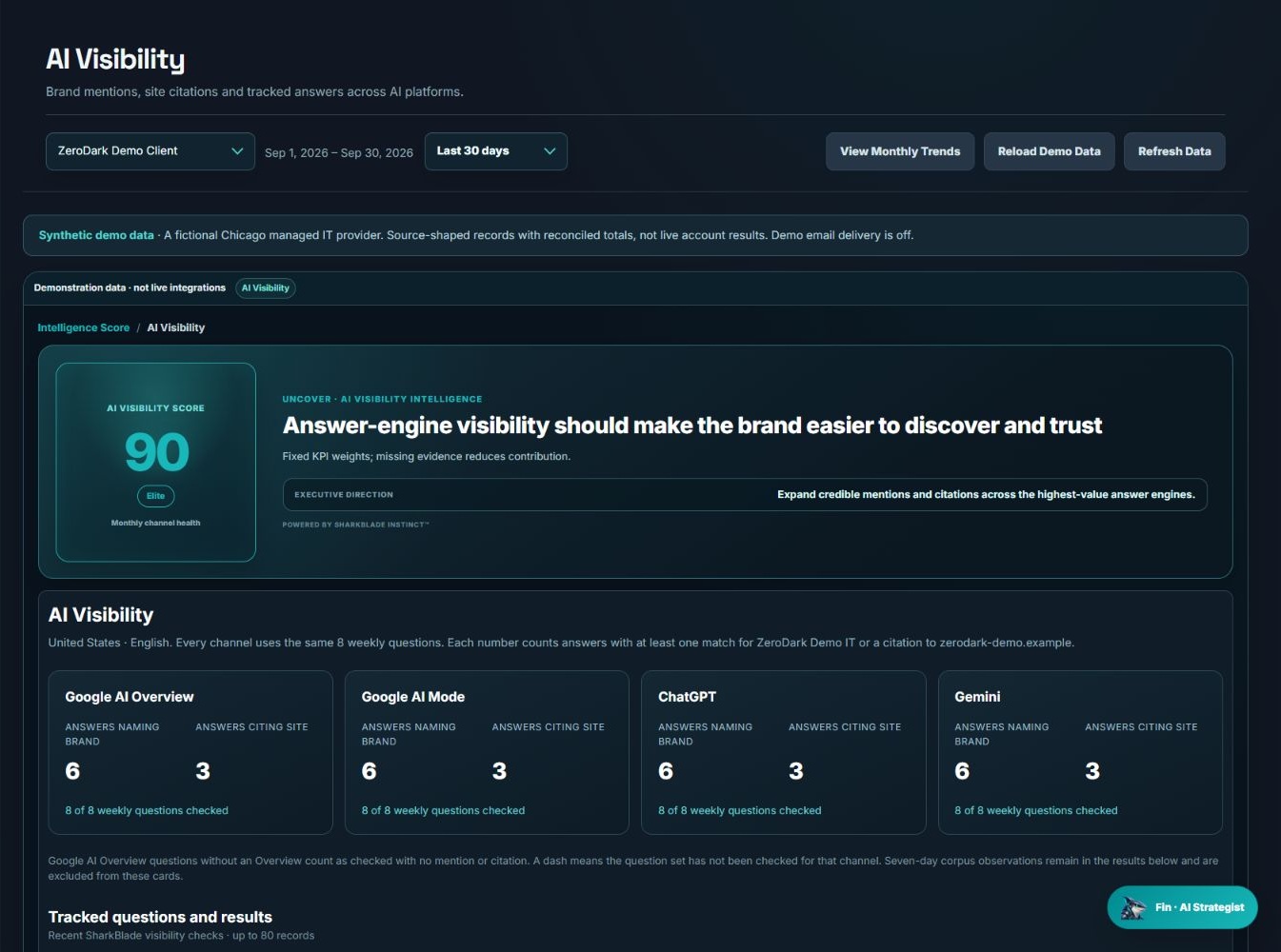
SharkBlade’s AI view makes the observation scope visible. The demo uses eight checked questions per platform and synthetic answers. Those observations are different from keyword positions and different again from website referral traffic. If a business is missing from an answer, inspect the question and sources before deciding on an intervention. The gap could concern relevance, a missing factual explanation or factors outside the website’s direct control. One absent result is not proof that a special “AI schema” is missing.
A practical improvement sequence
- Choose a commercially relevant buyer question and the page that should answer it.
- Identify missing facts, unclear language or unsupported claims on that page.
- Add genuinely useful explanation and evidence, preserving readable structure.
- Verify accessibility and internal links as part of the production launch checks.
- Revisit consistent search and answer observations alongside inquiry evidence.
Evaluate proposals by deliverables
Ask what will be researched, changed and checked, who owns the work, and which results remain outside the provider’s control. “Optimize for GEO” is not a sufficient scope by itself. A proposal should distinguish website improvements from guaranteed placement claims. The AI audit guide explains readiness versus observed presence. The improvement guide addresses how to select a next action. Together they provide a practical basis for decisions without treating terminology as a shortcut to rankings.