The difference is the job being done
Marketing reporting organizes observations so people can review them. Analytics investigates relationships and patterns in those observations. Marketing intelligence combines relevant evidence with business context to support a decision. A useful system can perform more than one of these jobs. These are practical distinctions, not claims that every vendor uses the terms identically. A product called a dashboard may include analysis. A product called intelligence may still require a strategist to interpret the result. Evaluate the workflow rather than the label.
Compare the outputs
| Job | Typical question | Useful output |
|---|---|---|
| Reporting | What happened in the period? | A dated summary with source and scope |
| Analytics | Where did the change occur? | A comparison by channel, page or campaign |
| Intelligence | What should we investigate or do next? | A reasoned priority with supporting evidence |
| Execution | Who will change the underlying experience? | An assigned, bounded piece of work |
For example, “sessions increased” is a report observation. Finding that most additional visits landed on an unrelated article is analysis. Deciding to improve the path from relevant articles to a service enquiry is a proposed action. The action still needs validation; the labels do not establish causation.
Walk through the demo evidence
SharkBlade’s demo Web Analytics screen shows 3,670 sessions for September and a rounded website conversion-rate display. The Lead Capture screen contains source-specific records and totals. Those views support different questions; they should not be forced to reconcile by assuming every visit, event and person is interchangeable.
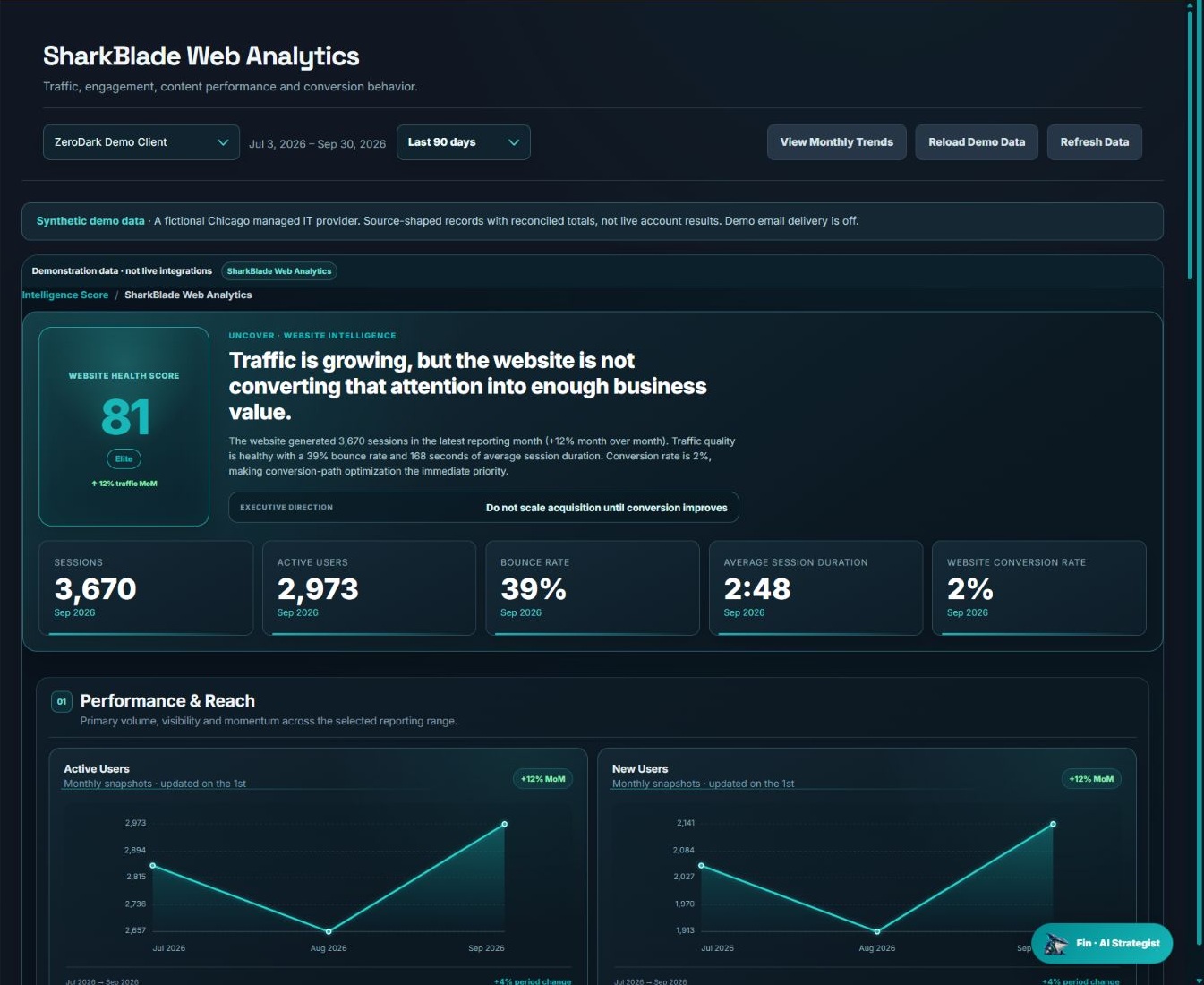
A reviewer could ask whether enquiry paths are working, inspect the relevant capture types, and test a form. The screenshot alone cannot show that a particular article produced a contract. Intelligence is stronger when it identifies both the decision and the missing evidence.
Choose the support you actually need
If your team can interpret the evidence and perform the work, platform access may be enough. If the uncertainty concerns priorities, a monthly strategist review can help connect observations to a decision. If the constraint is delivery capacity, an agreed expert-team scope addresses a different problem. SharkBlade is $299 per month; SharkBlade + Strategist is $499 per month. The expert marketing team option is Contact for Pricing because the work varies with business needs. Consult the pricing page for current terms rather than treating an article as a service contract.
Use a simple report-quality test
Pick a recommendation in the report. Can you find the underlying observation, the reporting period and an explanation of why the proposed work fits the business? Can someone own the action and verify its completion? If not, the next improvement may be clearer interpretation rather than another chart. Reporting remains essential: a decision without traceable evidence is difficult to review. The aim is to connect the summary, investigation and next action so each can be inspected.