A practical definition for a B2B owner
Marketing intelligence is the process of bringing relevant marketing evidence into a decision. It combines observations, definitions, business context and interpretation. Its useful output is an explainable priority, not simply a larger collection of charts. For a B2B owner, the question might be whether the business needs more relevant discovery, a clearer service explanation, a better enquiry path or a collection repair. The evidence required depends on that question. A public audit and connected ongoing reporting can contribute different information.
The evidence-to-decision chain
| Stage | Example question | Useful output |
|---|---|---|
| Observe | What happened in the relevant period? | A sourced metric or inspectable finding |
| Interpret | What could explain the observation? | Supported explanations and open questions |
| Decide | Which issue should receive attention? | A priority tied to the business objective |
| Execute | What will change and who owns it? | A bounded assignment |
| Review | What changed after the work? | Comparable evidence and a revised decision |
This sequence keeps a recommendation from becoming detached from its evidence. A favorable assessment can still contain unresolved issues, and an incomplete measurement can still require repair before a performance conclusion is possible.
A concrete SharkBlade example
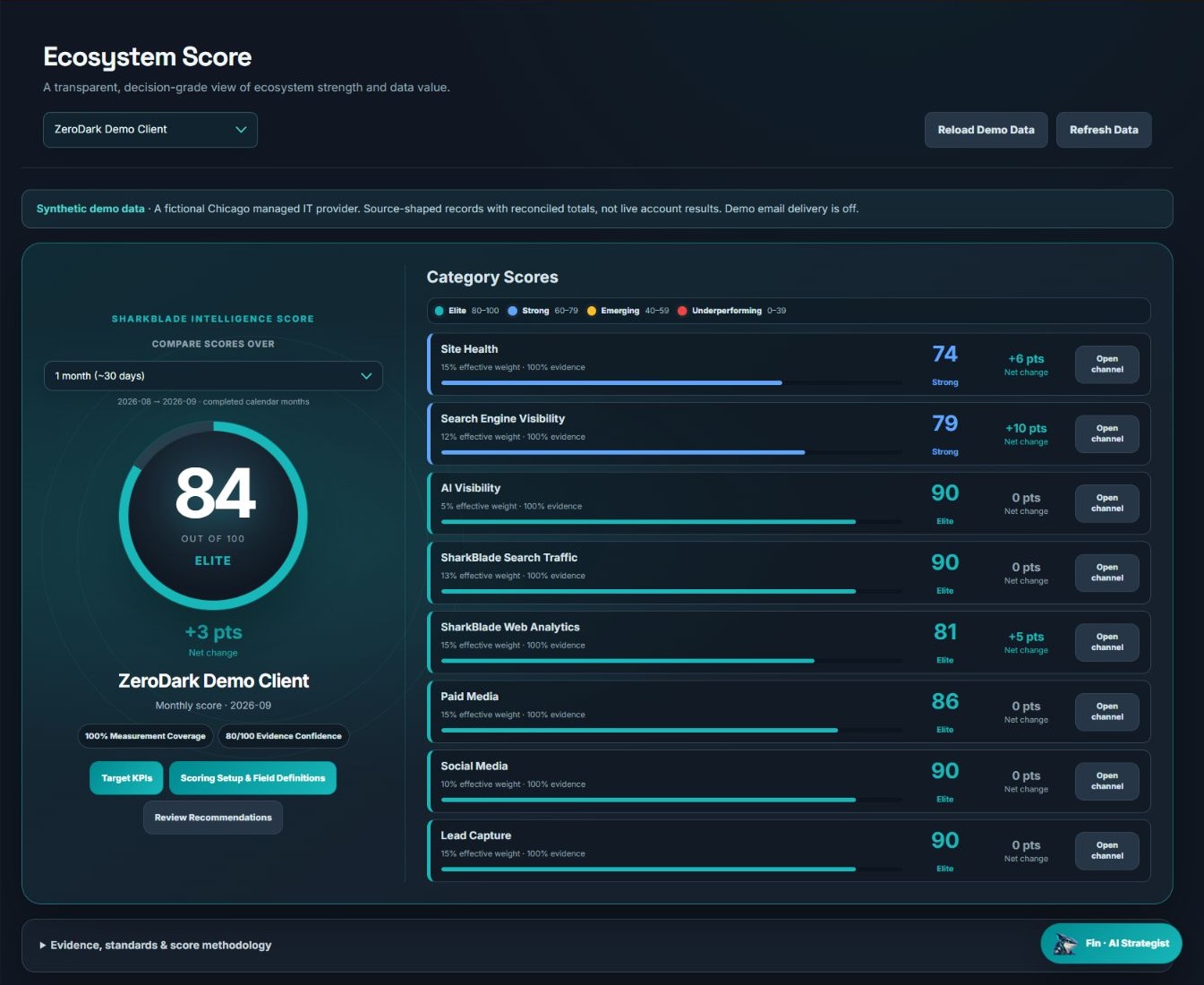
The demo shows an overall score of 84 and Site Health at 74. A useful conversation asks which underlying findings explain the weaker category and whether they affect an important buyer journey. Simply declaring the business “84% successful” would misread the assessment. All demo figures are synthetic for a fictional IT business. They demonstrate how the interface supports an investigation, not that ZeroDark achieved those results for a customer. The same care should apply to every example or benchmark used in a real review.
What marketing intelligence is not
It is not a substitute for business judgment or execution. A recommendation to test a form does not test it. A captured inquiry does not establish revenue. An AI-generated explanation still needs its assumptions and factual claims checked. It also does not require pretending that every useful measure belongs in one system. Source-specific detail or verified downstream records may be necessary to answer a question completely. A useful intelligence process identifies those gaps rather than silently filling them.
Choose a sensible starting point
If the business lacks a clear public baseline, a Digital Visibility Audit can help identify available website and search evidence without private account access. If the challenge is ongoing interpretation, SharkBlade supplies category intelligence, reporting and Fin. If the challenge is performing the improvements, a strategist discussion and agreed execution scope address the handoff. Ask a prospective provider to demonstrate one observation, its interpretation and the action it supports. If the team can explain all three and name what remains uncertain, the intelligence is becoming useful. Use the worked examples to see that process across several categories, and the discipline comparison to distinguish marketing intelligence from broader business intelligence or market research.