Define the metric before setting a target
A marketing KPI is useful when the team understands what it counts and which decision it informs. Write down the unit, reporting period, source and direction before choosing an expectation. A business-specific target cannot repair an ambiguous definition. The reference below combines supported SharkBlade evidence types with clearly named calculation examples. It is not a complete scoring specification, a universal benchmark table or a claim that every formula can be freely added to the platform.
A cross-category KPI reference
| Area | Measure | Definition or calculation | Interpretation check |
|---|---|---|---|
| Site Health | Crawl audit score | Source-reported audit assessment | Different from the category score |
| Site Health | Field LCP, INP and CLS | User-experience measures in their defined units | Preserve field scope and availability |
| Search Engine Visibility | Tracked keyword position | Observed position for a defined term and market | Keep the tracked set consistent |
| Search Traffic | Impressions and clicks | Search-result exposure and click observations | Apply the same query, page and market scope |
| Search Traffic | CTR | Clicks ÷ impressions × 100 | A changed query mix can change the rate |
| Web Analytics | Sessions | Collected periods of website interaction | Not identical to people or search clicks |
| Paid Media | Cost per reported conversion | Matched spend ÷ defined conversion actions | Not automatically cost per unique inquiry |
| Social Media | Engagements per impression | Defined engagements ÷ impressions × 100 | Providers can define engagements differently |
| AI Visibility | Sample mention rate | Mentioned answers ÷ checked answers × 100 | A sample observation, not universal market share |
| Lead Capture | Unique new inbound leads | Supported deduplicated inbound identity measure | Keep visitors and company signals separate |
Three example calculations
For a hypothetical search scope, 200 clicks from 10,000 impressions gives a 2% CTR. If the next period has 240 clicks from 15,000 impressions, CTR is 1.6%. More clicks and a lower rate can both be true. Using the synthetic social screenshot counts, 551 engagements divided by 13,560 impressions is approximately 4.06%. Name the formula rather than assuming it is every network’s official engagement rate. Using the demo AI sample, six mentions in eight checked answers is 75%; that differs from the displayed category score of 90.
Keep assessment separate from observation
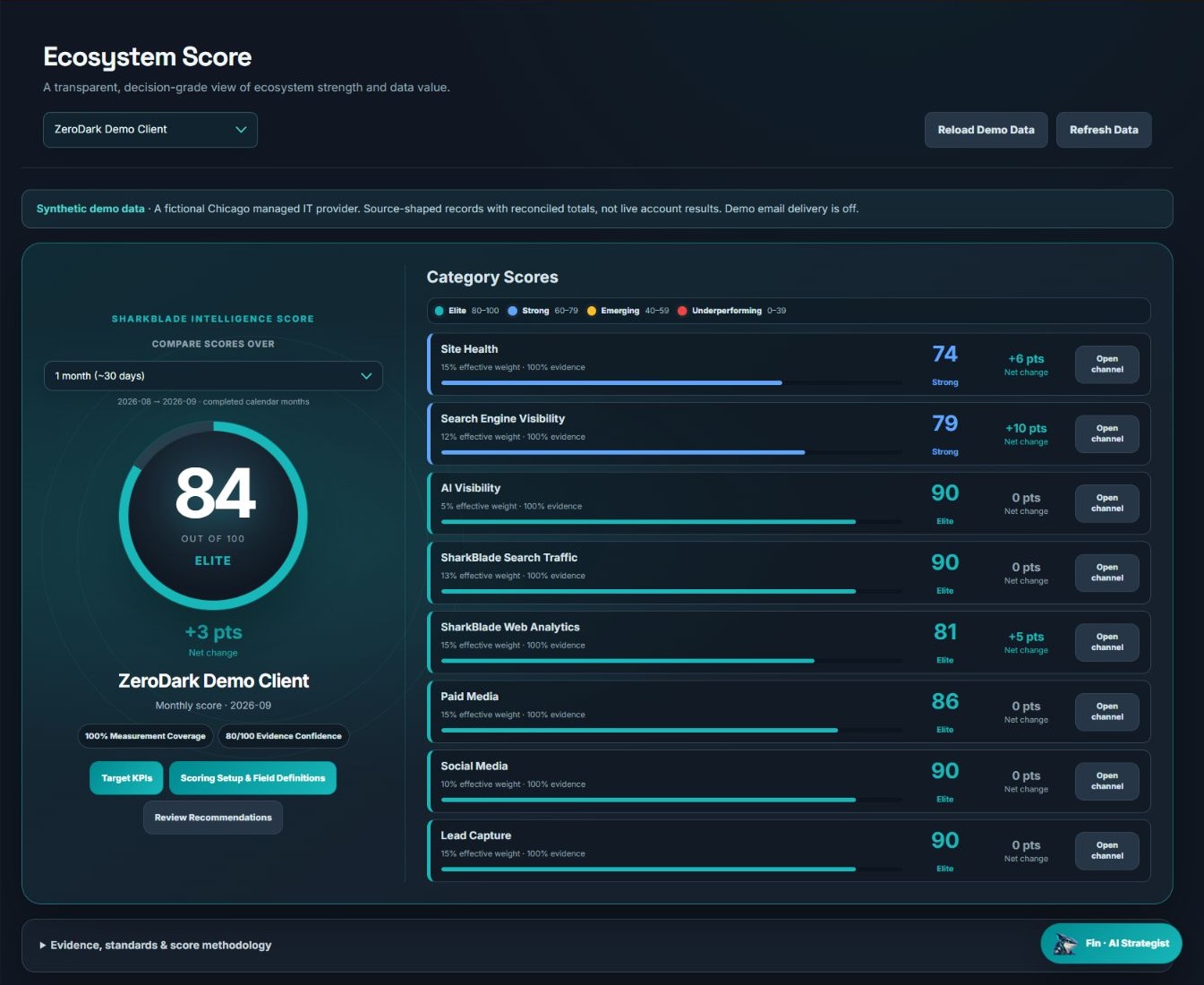
A raw KPI, its assessment against a supported target, a category result and the overall score serve different purposes. In the demo, an overall 84 is not an 84% website conversion rate. Review field definitions and configuration before translating a score into a business conclusion.
Extend the worksheet for your business
Add columns for owner, source, period, target rationale, coverage and review date. Where a required outcome depends on downstream qualification or finance records, identify that evidence explicitly. Do not describe an unavailable revenue measure as a native marketing result. Select a small decision set for each review, then retain the supporting detail. A large table of metrics is less useful than a clear explanation of which question each measure answers and what action a change might justify.
Explore the next step
Supporting documentation
Google: Search Console performance report ↗Google Analytics: session definitions ↗Google Ads: conversion measurement ↗Google: Core Web Vitals definitions ↗