Treat the scorecard as an index to the evidence
A marketing scorecard organizes selected measures around business objectives. Its value is that a reviewer can quickly find a gap and then inspect the evidence. A compact scorecard becomes misleading when a favorable color is treated as sufficient proof of business success. SharkBlade combines category assessments with underlying KPIs and reporting context. The supported targets can reflect the business, while the definitions explain what is being counted. Keep the raw measure, assessment and proposed action visible together.
A practical scorecard reading order
| Layer | Example | Interpretation |
|---|---|---|
| Raw observation | A count, rate, field-performance value or captured record | What the source measured |
| Target assessment | The measure against its supported target | How it compares with the agreed basis |
| Category result | Site Health or Lead Capture assessment | A summarized area for investigation |
| Overall result | Intelligence Score | The combined assessment for the selected scope |
| Business outcome | Qualified opportunity or contract | A separate claim requiring verified downstream evidence |
Read the demo without confusing its layers
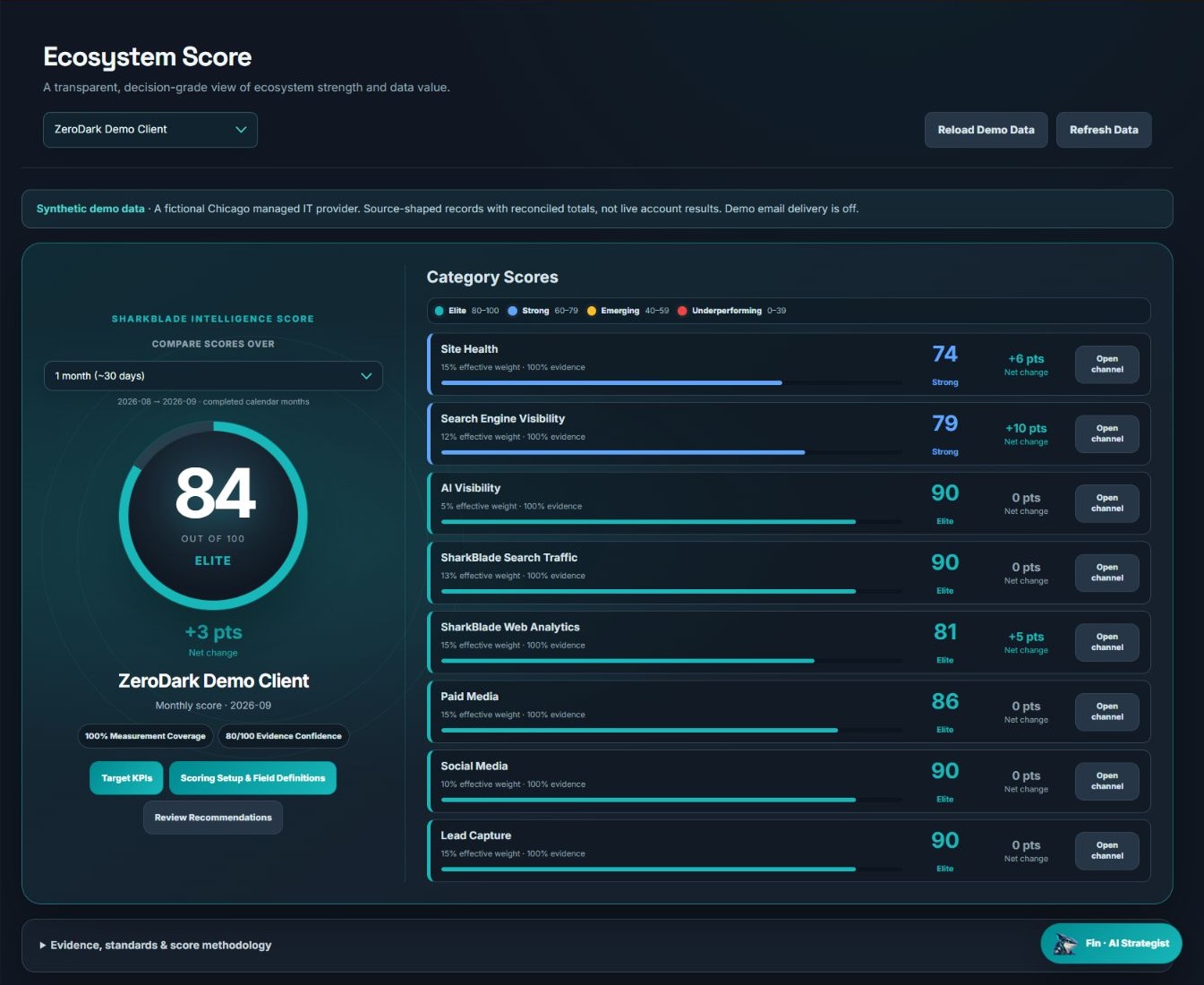
The demo’s overall score is 84. Site Health is 74; Lead Capture is 90. Those values are assessments, not percentages of visitors who became customers. A higher Lead Capture assessment does not show how many opportunities the sales team accepted or what revenue followed. If the business needs more suitable enquiries, inspect the supporting capture measures and the enquiry journey. If the website is difficult to use, inspect the relevant technical findings. A lower score can help direct attention, but the proposed work must match the actual issue.
Create a small decision scorecard beside the report
For a hypothetical monthly review, write one row per priority with the measure, period, target rationale, evidence limitation and owner. Avoid listing every available metric merely because it fits on the page.
- Acquisition question: Are relevant people finding the priority service information?
- Experience question: Can those visitors use the page and complete the intended next step?
- Capture question: Did supported sources deliver identifiable enquiries with useful context?
- Review question: Which specific change should be tested next?
These are review questions rather than additional SharkBlade scoring categories. Where a required measure is outside the platform or unavailable, identify the missing evidence instead of filling the cell with a favorable assumption.
Watch for misleading improvements
A changed target, added source or revised event definition can alter the assessment. A scorecard should make those changes understandable. Compare raw values over comparable periods and document the reason for any configuration change. The aim is a repeatable conversation about decisions. The B2B KPI reference supplies definitions and formulas; the target-setting guide explains how to choose appropriate supported expectations. Together they keep the scorecard useful without treating the score as the business objective itself.