Start with the decision behind the number
SharkBlade’s proprietary scoring condenses supported marketing evidence into an overall assessment and category views. It helps a reviewer decide where to investigate. It does not turn every marketing activity into a sale, and it should not replace the underlying KPI evidence. The demo intelligence screen provides a useful example. It shows 84/100 overall, up three points, with Site Health at 74 and Search Engine Visibility at 79. Both categories can deserve investigation even while the overall assessment is labeled Elite. These are synthetic demonstration values for a fictional business.
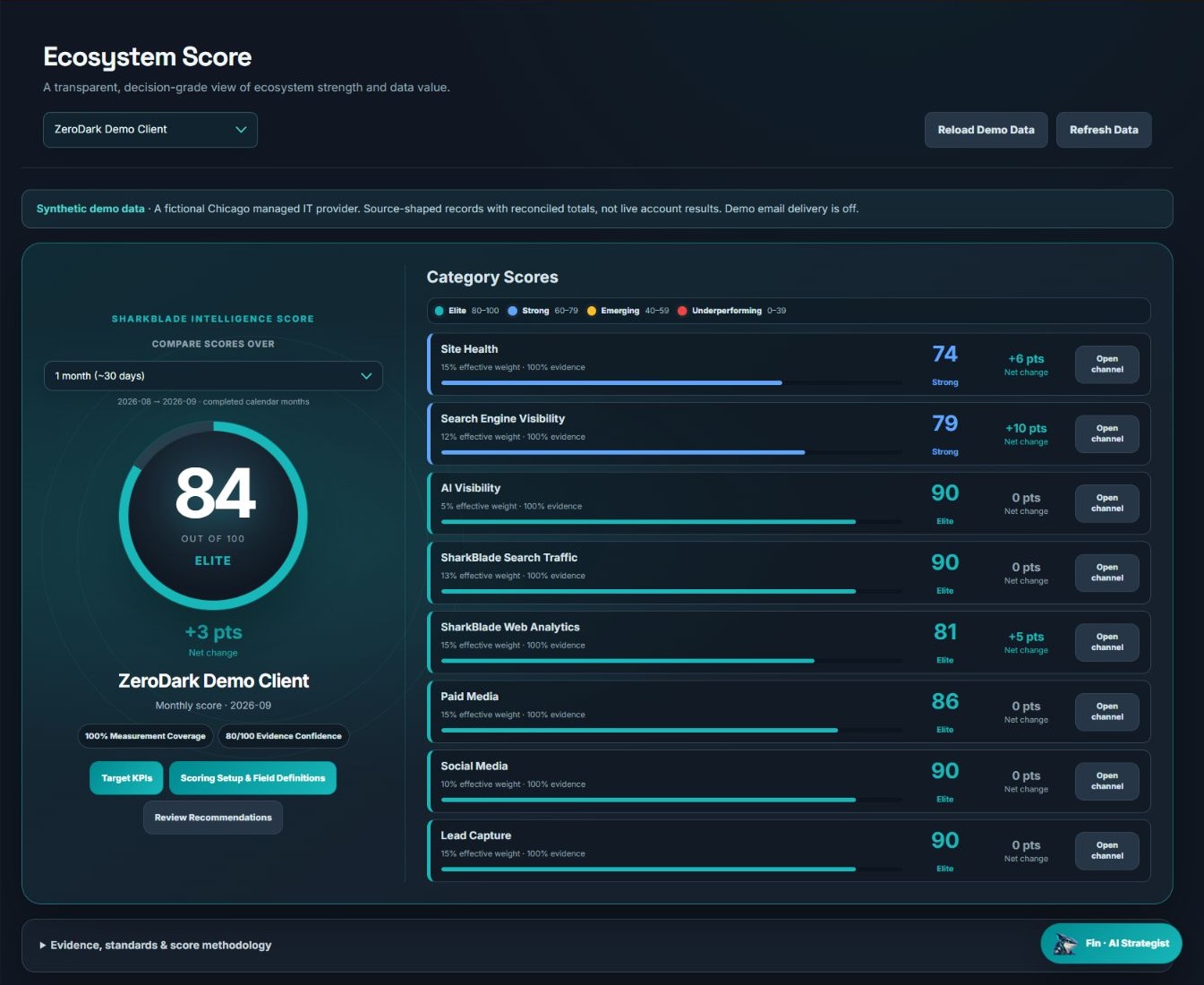
Read four different things separately
| Display | Question it answers | Mistake to avoid |
|---|---|---|
| Overall score | What is the combined assessment for this scope? | Treating 84 as a conversion rate |
| Category score | Which area warrants a closer look? | Assuming every category has the same business impact |
| Effective weight | How much does this category contribute in this view? | Assuming the screenshot’s weights apply to every business |
| Measurement coverage and confidence | What evidence supports the assessment? | Treating missing evidence as a measured poor result |
The displayed weights belong to the illustrated configuration. Supported business targets and thresholds, category eligibility and the scoring methodology must be understood in context. A website article cannot substitute for the workspace’s field definitions.
Follow the lower category into its KPIs
In the demo monthly report, Site Health is 74 while the crawl audit metric is 88. There is no contradiction: a category assessment considers more than the crawl-audit number. The same report includes field-performance and indexability evidence. Reading only the strongest underlying metric would miss the reason for the category result. The operational response is to identify the affected page or experience, assign a repair, and save the evidence used to choose it. A score provides orientation; the underlying issue determines the work. Do not buy unrelated activity simply because it belongs to the same category.
Explain movement before celebrating it
Ask whether the comparison covers completed months, whether definitions stayed consistent, and whether new evidence became available. A changed score can reflect performance, a changed target or a changed measurement basis. Those explanations lead to different decisions.
- Performance changed: inspect the relevant raw KPI and the work performed.
- Coverage changed: document the newly measured source or period.
- Configuration changed: preserve the previous comparison basis in the review notes.
Turn the review into an assignment
A useful action names an owner, a specific intervention and the evidence to revisit. “Investigate the broken internal links affecting enquiry pages” is more actionable than “increase the score.” SharkBlade supplies intelligence and reporting; your team or ZeroDark performs the agreed work. Subsequent reports can show what changed, while attribution of that change still requires judgment.