Start with the report’s evidence statement
The demoaudit.com report is an authored fictional demonstration. It is not the result of a live crawl, keyword request or private-account analysis. Its purpose is to show the existing audit’s format and how a prospect could interpret findings. The cover and methodology identify synthetic inputs. Read those boundaries before interpreting any number. A polished report does not turn an illustrative value into a verified observation about a real business.
Pages 2–4: business context, ratings and overview
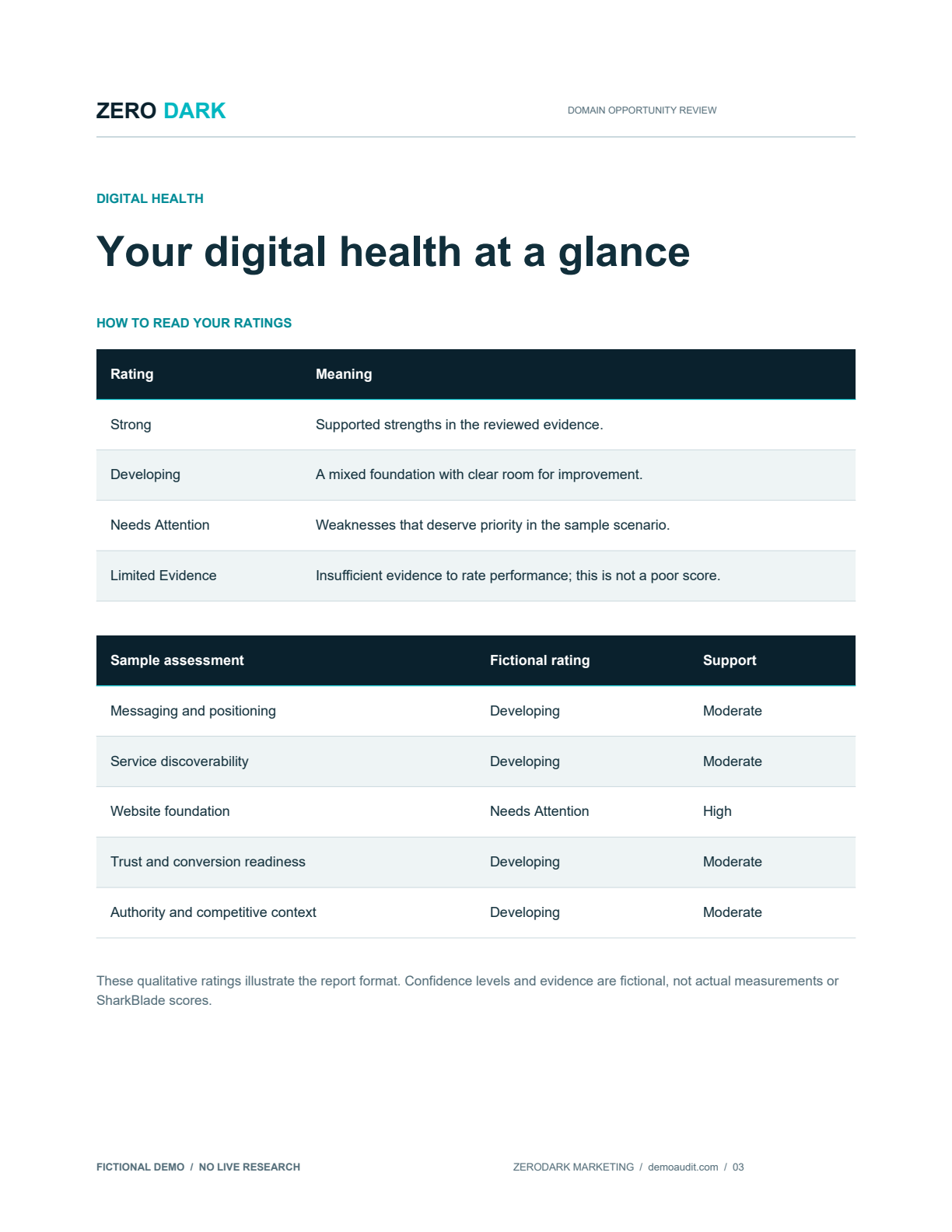
The opening pages explain why discovery and clarity matter, define the rating language and introduce the fictional business scenario. Page 3 distinguishes supported strengths, developing areas, issues needing attention and limited evidence. Those labels are not interchangeable with the recurring SharkBlade category scores.
Page 4 describes a fictional IT provider whose broad service explanation leaves important buyer questions unresolved. The useful interpretation is a content and journey question: what information would help an appropriate prospect evaluate the service and take a next step?
Pages 5–12: discovery and content direction
The report illustrates service discoverability, a search baseline, current keyword examples and candidate content opportunities. Page 7 contains synthetic figures including 240 ranking keywords and 36 in the top ten. They are fictional sample values, not current DataForSEO research for ZeroDark or demoaudit.com. Pages 10–12 connect example opportunities with possible page content. A candidate keyword is not an instruction to create a page automatically. Its relevance, intent and existing coverage still require validation. The appropriate response may be improving a service explanation rather than adding another article.
Pages 13–16: implementation checks and competitive context
These pages illustrate sampled page fields, technical findings and fictional competitor candidates using reserved .example domains. A real implementation should reproduce suspected issues before making changes. A missing description or repeated heading in the sample fixture is not proof that the corresponding issue exists on a live website. The competitive examples explain how search-result competitors can differ from the businesses encountered by a sales team. They do not identify actual rival companies or establish their performance.
Pages 17–19: priorities, method and roadmap
The closing sequence turns observations into a practical order of work and explains the synthetic methodology. A useful action plan names the affected issue, the next check and the evidence needed to evaluate improvement. It should distinguish confirmed observations from hypotheses.
Use the sample to ask better questions
| Question | Why it matters |
|---|---|
| What was actually reviewed? | Establishes evidence scope |
| Which values are estimates or illustrations? | Prevents false precision |
| Why is this recommendation a priority? | Connects findings with the business |
| Who will perform the work? | Makes execution assignable |
| What will be measured afterward? | Creates a basis for review |
The free audit offer and report are unchanged. SharkBlade serves the separate ongoing intelligence stage, with connected evidence, category assessments and recurring reporting where supported. Use the checklist to understand the public review and the report example to understand the continuing monthly conversation.