Explain discovery before summarizing success
An SEO report should help the business understand whether useful information is becoming discoverable to relevant buyers. Rankings, impressions, clicks and website inquiries are connected questions, but they are not interchangeable outcomes. State the domain, market, selected pages or queries, reporting period and comparison basis. Separate a stable tracked-keyword set from broader Search Console observations. Changing the tracked terms can change a summary even when underlying pages have not improved.
A reusable SEO report outline
| Section | Evidence to include | Interpretation question |
|---|---|---|
| Scope | Market, dates, tracked terms and source coverage | Are periods comparable? |
| Visibility | Relevant tracked positions and search exposure | Are suitable buyer questions represented? |
| Search response | Impressions, clicks and CTR | Did query or page mix change? |
| Landing pages | Relevant destinations and inquiry paths | Does the page satisfy the intent? |
| Technical context | Confirmed findings affecting useful pages | Is there a discovery or usability blocker? |
| Next action | Specific change, owner and review measure | What evidence supports the priority? |
Read the demo as an example of structure
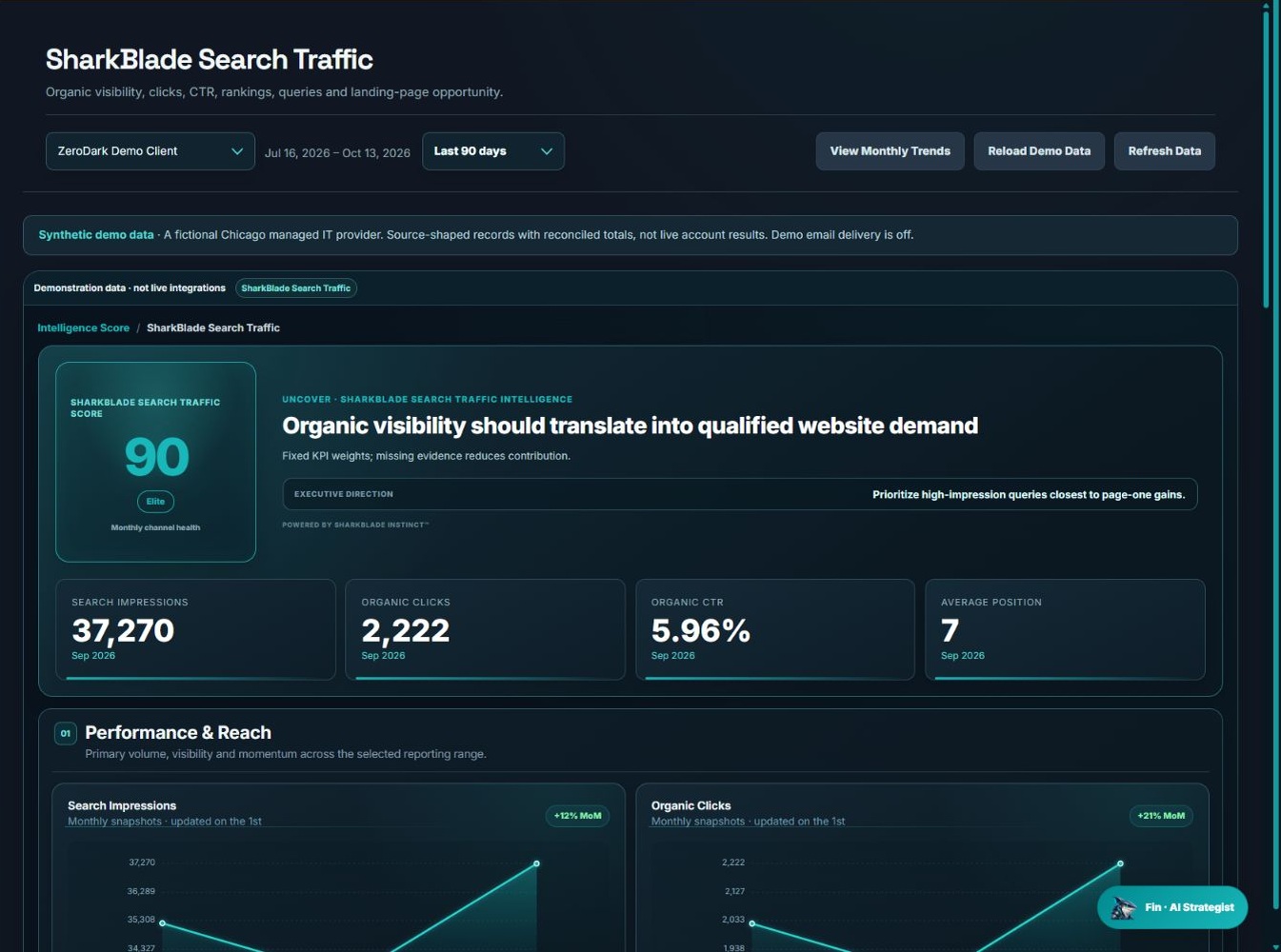
The demo demonstrates how source evidence can be presented. Its synthetic values should not be used as a benchmark or as proof that a particular SEO action worked. Use the relevant category and underlying measures as context, and verify page-level detail when evaluating a particular article.
A worked hypothetical narrative
Suppose a service topic receives 10,000 impressions and 200 clicks in one period, then 15,000 impressions and 240 clicks in the next. CTR changes from 2% to 1.6%. The report should describe both the extra clicks and the lower rate, then inspect whether the new exposure matches the intended buyer need. If visits rise while verified inquiries remain flat, review landing-page intent, collection and the next-step path. The data does not automatically justify more articles or prove existing content is ineffective. A targeted page improvement may be a better test.
Keep estimates and observed measures distinct
Keyword research volumes are provider estimates. Search Console impressions and clicks are collected search observations within the report’s scope. Analytics sessions describe website interaction under a different measurement system. Do not combine them into an implied customer count. For a captured inquiry, preserve the actual source and identity evidence where available. Sales qualification and revenue need their own verified records. An SEO report is stronger when it explains those boundaries rather than claiming full-funnel attribution from a position chart.
Write an action that can be reviewed
An illustrative priority might be: “Clarify the capability explanation on the relevant service page, add a useful supporting guide, and verify the enquiry path.” Record the change date and revisit relevant queries, destination behavior and inquiry evidence over comparable periods. Keep a short list of material actions and unresolved questions. The monthly marketing report combines this evidence with other categories; the organic review guide supplies a diagnostic sequence for the search portion.
Explore the next step
Supporting documentation
Google: Search Console performance report ↗Google Analytics: session definitions ↗